Huijue Technology Group Site Stacked PV Solution
The site stacked PV solution combines the clean and renewable attributes of solar energy with the stringent power supply requirements of communication base stations, delivering prominent strengths and broad application prospects.
The site stacked PV solution integrates the clean and renewable properties of solar energy with the strict power supply requirements of communication base stations, boasting prominent advantages and broad application prospects.
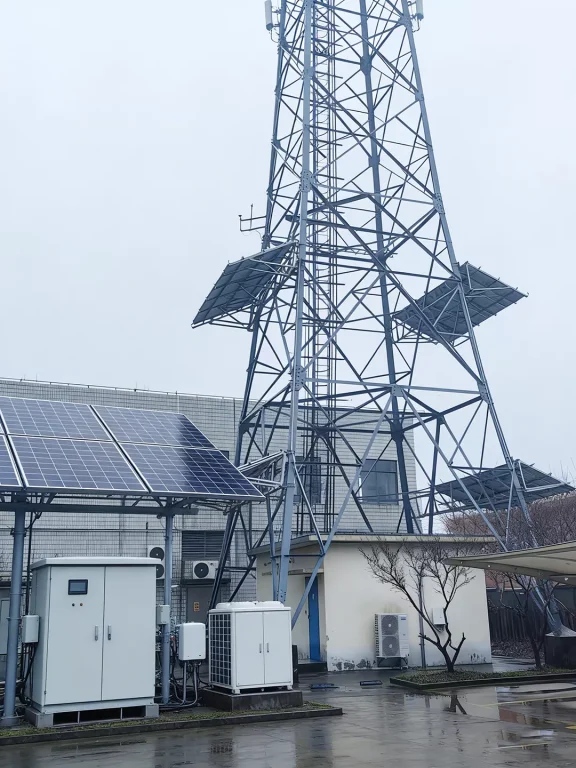
Core Solution Principles:
- The original power supply can operate without interruption
- PV power generation units are superimposed and connected to the existing power supply architecture via DC coupling
- Solar power is prioritized to supply loads
I. System Composition
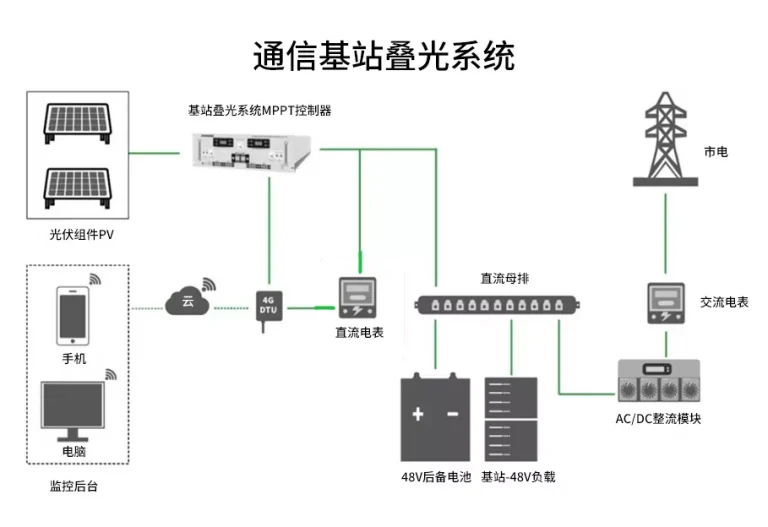
The base station stacked PV power supply system mainly consists of PV arrays (solar panels), stacked PV controllers (such as MPPT controllers), new energy battery packs, PV mounting brackets, power transmission and distribution cables and other components, forming an efficient, intelligent and reliable closed-loop green energy system. This architectural design balances power generation efficiency, operational safety and convenient maintenance to guarantee stable power supply under various complex environments.
| No. | Equipment Name | Function Description |
| 1 | PV Modules | Fabricated from monocrystalline silicon or high-efficiency polycrystalline silicon materials, installed on machine room roofs, tower facades or ground brackets. They convert solar energy into DC power and serve as the energy input source of the whole system. |
| 2 | Stacked PV Controller | Integrated with an MPPT (Maximum Power Point Tracking) module to optimize real-time PV output efficiency by 15%-25%. Equipped with multiple safety functions including input air switches, lightning protection and output fuses, acting as the core control unit. |
| 3 | Input Air Switch + Lightning Protection Device | Provides protection against overload, short circuit and lightning surge, securing system operation under harsh weather and preventing equipment damage from external electrical shocks. |
| 4 | Output Fuse | Installed on the negative output pole to avoid reverse impact of abnormal current or damage to back-end communication load equipment, ensuring power supply safety. |
| 5 | DC Energy Meter | Monitors real-time PV power generation and load power consumption data, delivering accurate data support for energy consumption analysis, benefit evaluation and remote management. |
| 6 | RTU Module | Supports remote monitoring and data uploading, seamlessly docking with the base station environmental monitoring system to realize unattended operation, fault early warning and visual status management. |
| 7 | Mains Power Supplementary System | When sunlight is insufficient or at night, the original switching power supply automatically rectifies mains power for supplementary power to guarantee uninterrupted supply. Voltage fluctuation during switching is controlled within 0.1V without disrupting normal operation of communication equipment. |
| 8 | Brackets & Cables | Used to fix PV modules and transmit electric power. Specifications are reasonably selected according to power and transmission distance to effectively reduce line loss and ensure structural stability and electrical reliability. |
II. Working Principle
- Solar Energy Collection: PV arrays (solar panels) generate direct current under sunlight irradiation.
- Electric Energy Conversion: Stacked PV controllers (MPPT controllers) efficiently convert DC power generated by PV arrays and adjust output voltage and current to match power consumption demands of communication base stations.
- Electric Energy Storage: Converted electric power first supplies communication base station loads; surplus power is stored in battery packs for use during sunless periods or peak power demand hours.
- Intelligent Monitoring: The system is equipped with remote monitoring functions to track real-time operating status and power output of the solar power supply system, ensuring stable and efficient power delivery.
III. Solution Features
The solution has been verified for stability and adaptability in multiple complex environments, enabling efficient deployment and stable operation for dense urban sites, remote areas without mains power, and space-constrained communication towers alike.
- High Efficiency & Energy Saving: Adopts direct DC power supply mode to eliminate up to 15% AC-DC conversion loss inherent in traditional AC systems, with overall link efficiency ≥95% and a measured maximum of 98.3%. A typical site can save around 2,920 kWh electricity annually, boosting power generation gain by 10%-30% compared with AC solutions.
- Cost Reduction: Annual electricity expenses for a single site can drop by up to RMB 20,000, with an investment payback period of approximately 5.5 years; local subsidies can further shorten the payback cycle. No grid connection approval is required, simplifying deployment procedures and drastically cutting institutional transaction costs.
- High Reliability: Sustains power supply during mains outages under daylight conditions; paired with energy storage, it delivers over 5 days of backup power on rainy days, cutting emergency power generation demand by more than 80% and significantly reducing base station outage risks to guarantee continuous network operation.
- Outstanding Environmental Benefits: A single site equipped with 18 SPV modules generates an estimated annual power output of 7,671 kWh, equivalent to a 4.374-ton reduction in CO₂ emissions. Projects across Liaoning Province can cut carbon emissions by 267,000 tons per year, delivering remarkable environmental value.
- Easy Installation & Strong Adaptability: Renovation work can be completed without power cut, compatible with original power supply systems from all manufacturers and models. Suitable for multiple spatial scenarios including rooftops, tower facades and ground brackets with high deployment flexibility.
- Strong Policy Compatibility: The self-consumption model is exempt from grid connection approval restrictions, aligning with MIIT’s target of over 30% PV coverage for newly built base stations and national distributed energy development policies, facilitating rapid large-scale promotion.
IV. Application Scenarios
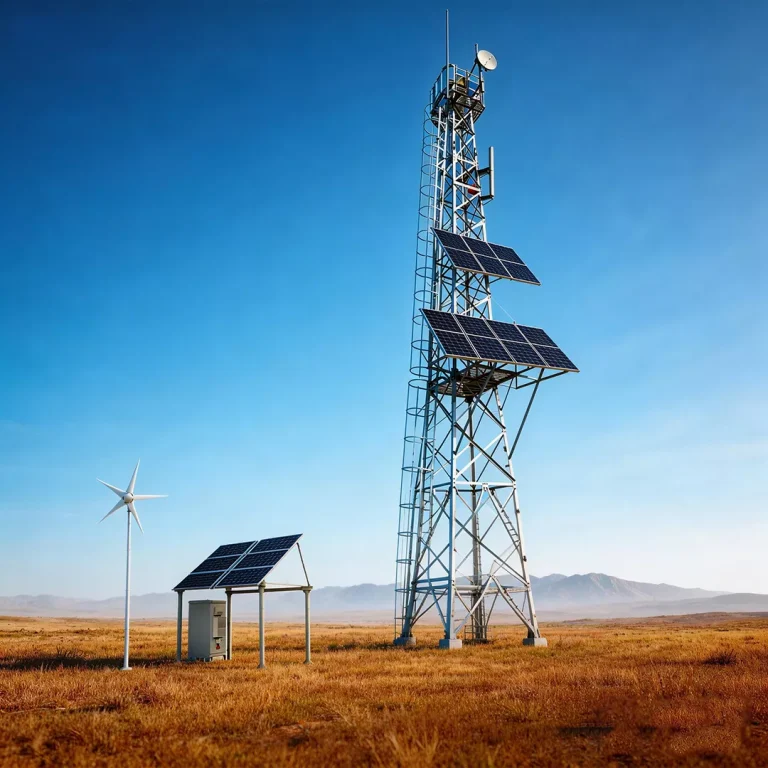
The base station stacked PV power supply system applies to all types of communication base stations, including macro base stations, micro base stations, 4G/5G base stations, etc. It delivers unique advantages especially in remote areas without national grid coverage or unstable power supply. Through the smart energy model of “on-site generation for self-consumption and local absorption”, the solution effectively reduces reliance on mains power and provides stable, reliable power support for communication base stations.
V. Solution Classification
1. Classification by Installation Scenario & Space Utilization
Rooftop Stacked PV Solution
- Applicable Scenarios: Macro base stations and convergence nodes with independent machine rooms or cabinet tops.
- Features: PV modules are laid on idle existing machine room rooftops. This is the most traditional stacked PV form with relatively simple construction, yet limited installed capacity due to roof area and load-bearing constraints.
Tower/Mast Stacked PV Solution
- Applicable Scenarios: Dense urban areas, land-scarce regions, outdoor cabinet sites without independent machine rooms.
- Features: PV modules are vertically or obliquely mounted on communication tower bodies, poles or beautification covers (namely minimalist tower-mounted stacked PV).
- Advantages: Occupies no extra ground or rooftop space to solve the “land shortage” challenge in cities; vertical installation boasts excellent wind resistance and less dust accumulation.
Facade/Wall Stacked PV Solution
- Applicable Scenarios: Vertical surfaces such as machine room exterior walls, site enclosures and noise barriers.
- Features: PV panels are installed on vertical building surfaces around the site as supplementary energy sources.
2. Classification by Electrical Coupling Mode
DC Coupling Stacked PV Solution
- Working Principle: DC power generated by PV panels is directly converted to standard -48V DC power for communication equipment via DC stacked PV controllers (DC/DC converters), then connected to the site DC busbar.
- Features:
- High Efficiency: Eliminates secondary conversion loss of “DC-AC-DC”.
- Convenient Renovation: No modification to the original AC power supply architecture; parallel connection to switching power supply systems for plug-and-play deployment.
- Mainstream Option: The most widely adopted model for energy-saving retrofits of communication base stations at present.
AC Coupling Stacked PV Solution
- Working Principle: PV power is converted to alternating current via inverters, connected to the site AC distribution box, then rectified into DC power to supply loads.
- Features: Suitable for large-scale sites or scenarios requiring power supply for AC loads such as air conditioners simultaneously, yet slightly lower in efficiency than DC stacked PV for pure communication loads.
3. Classification by System Functions & Evolution Targets
Basic Stacked PV Solution
- Target: Pure electricity cost saving.
- Composition: PV modules + stacked PV controller.
- Logic: Solar power is used when sunlight is available; the system automatically switches back to mains power without sunlight, mainly cutting operational electricity expenditure (OPEX).
PV + Energy Storage Stacked Solution
- Target: Power saving + enhanced backup power capacity.
- Composition: PV + lithium batteries + stacked PV controller + intelligent energy management system.
- Logic: PV power prioritizes load supply, with surplus power stored in lithium batteries; batteries discharge during mains power outages. Enables peak shaving and valley filling (charging via low-price mains or PV power, discharging during high-price periods) and extends backup power duration.
Integrated PV + Storage + Generator / Grid Hybrid Solution
- Target: Ultimate green performance and ultra-high reliability (widely applied in power-shortage regions or high-power-consumption 5G sites).
- Composition: PV + energy storage + intelligent dispatching system (with optional generator interfaces).
- Logic: EMS intelligently dispatches four energy sources: solar PV, energy storage, mains grid and diesel generators.