Nation’s First Energy Storage REITs Lands, Unlocking the Trillion-Yuan Gate for Asset Securitization
Recently, what has truly catapulted the energy storage sector into the spotlight is neither a groundbreaking technological breakthrough nor an ultra-large-scale project, but a financing deal: a 200MW/800MWh standalone energy storage power station in Jiuquan, Gansu Province has secured China’s first inter-institutional REITs for energy storage assets. The project has been accepted by the Shanghai Stock Exchange and entered the review feedback phase, with a proposed issuance size of 451 million yuan.
I. It Is Not Technology Going Viral, But a Shift in the “Asset Logic”
Recently, what has truly made the energy storage industry gain widespread attention is neither a major technological breakthrough nor an ultra-large-scale project, but a financing deal: a 200MW/800MWh standalone energy storage power station in Jiuquan, Gansu Province has secured China’s first inter-institutional REITs for energy storage assets. The project has been accepted by the Shanghai Stock Exchange and entered the review feedback phase, with a proposed issuance scale of 451 million yuan.
Judging by scale alone, this deal may not seem particularly striking, yet it sends an unambiguous signal: energy storage power stations are starting to be treated as “securitizable assets”. This is the first clear verification of such a model in China’s market, and it means the long-missing link for the energy storage industry — an “exit channel” — is gradually opening up.
Over the past few years, development paths for energy storage projects have remained relatively limited: projects either rely on bank loans or rolling investment funded by enterprises’ own capital, essentially following a logic of “borrowing money to build projects”. This leads to lengthy capital recovery cycles and restricts expansion capacity. The emergence of REITs reshapes this underlying framework — investors are shifting their focus from “evaluating enterprises” to “evaluating assets”.
In other words, capital is willing to invest in this power station not because of the enterprise’s size, but because the station’s earnings over the next 8 to 10 years are calculable and verifiable. As long as the asset itself can generate steady returns, even smaller enterprises stand a chance to secure financing. At the same time, securitization allows future earnings to be discounted in advance, enabling developers to recover funds more rapidly for reinvestment in new projects. Though it appears to be merely a change in financing methods, it essentially endows energy storage with distinct “financial attributes”.
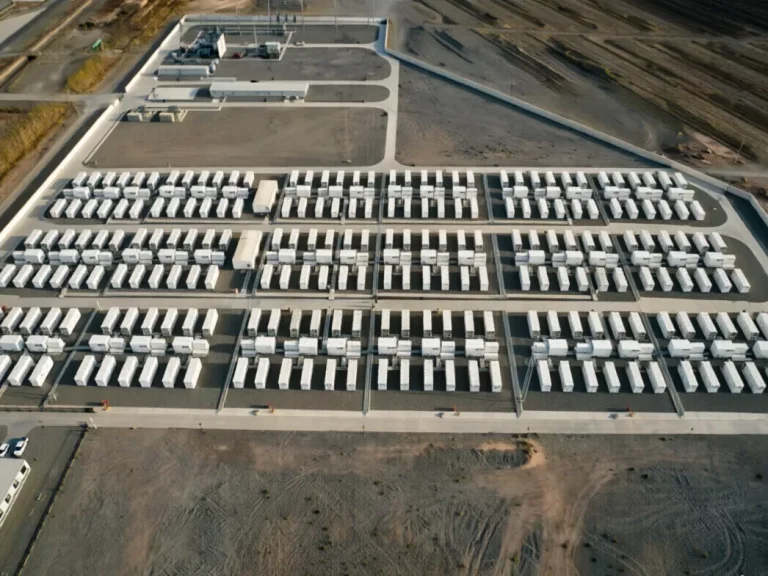
II. Why Jiuquan, Gansu? Behind It Lies “Verifiable Earnings”
This project being located in Jiuquan, Gansu is no accident, but the result of the superposition of several key conditions.
First, capacity tariffs. The local capacity tariff reaches 330 yuan/kW/year, ranking among the highest nationwide. This income stream provides a stable “underlying cash flow” for the project and serves as a core basis for investors to assess project value.
Second, the power market environment. Gansu is one of China’s earliest regions to roll out electricity spot markets. This project has already been grid-connected, with real data supporting its charge-discharge strategies, arbitrage margins and frequency regulation capacity. Compared with “theoretical models”, such market-verified data carries greater persuasion and delivers more controllable earnings expectations.
Yet the more critical factor lies in the project’s inherent attribute: it is a standalone energy storage power station. Only standalone energy storage facilities feature clear grid interconnection relationships, independent revenue sources and unambiguous asset ownership. In contrast, mandatory supporting storage attached to wind and photovoltaic power plants mostly act as auxiliary assets, with inseparable earnings and vague ownership — traits that make them hard to gain recognition in capital markets. From this perspective, this REITs deal also sets an implicit threshold: only fully independent, measurable and operable energy storage assets can lay the foundation for securitization.
III. From “Splitting Assets for Sale” to “Whole-Asset Holding”: Structural Transformation Is Underway
In terms of product structure, this round of “inter-institutional REITs” also reflects an obvious shift. Traditional ABS products generally adopt senior/subordinated tranche division to segment risks through structural design, which essentially means “splitting assets to sell separately”. By contrast, this deal follows a logic closer to “whole-asset holding” — taking the entire energy storage power station as an integrated asset portfolio for long-term holding by professional investors.
Though this model seems simpler, it imposes higher requirements on the underlying assets. Without complex structural arrangements to disperse risks, returns ultimately rely entirely on the asset’s actual operational performance. This business logic has already proven viable overseas: many energy platforms focus on acquiring and holding renewable energy assets with stable cash flows over the long term, generating returns via sustained operation.
From this perspective, energy storage REITs are not an isolated innovation, but a domestic implementation of the global trend toward financialization of energy assets.
IV. What Kinds of Energy Storage Assets Are Accepted by Capital?
The truly significant implication of this project is that it answers a core question: what types of energy storage assets can be absorbed by capital markets?
The answer is gradually clear: standalone energy storage facilities with clear earnings models, stable cash flows and authentic, verifiable operational data. These conditions form the fundamental threshold for energy storage assetization. Once incorporated into this system, an energy storage power station is no longer merely a “combination of equipment”, but a carrier for long-term returns.
This also means the stability, safety and long-term operational capacity of the system will directly determine asset value. Indicators that were once purely technical — such as battery consistency, cycle life, system integration capability and energy management strategies — will all translate into reflections of “earnings stability” in the assetization stage.
In other words, competition logic in the energy storage industry is shifting dramatically: from the past standard of “who can complete project construction” to “who can develop projects into tradable, priceable assets”.
V. From Equipment to Assets: Energy Storage Competition Enters a New Stage
Driven by this trend, energy storage systems themselves are undergoing transformation. A growing number of projects adopt highly integrated energy storage solutions. Standardized containerized designs integrate batteries, PCS, temperature control, fire protection and other subsystems as a whole to boost deployment efficiency and operational stability. Meanwhile, batteries are prioritized for high consistency and long cycle life to guarantee sustained long-term profitability.
In addition, intelligent energy management systems have become a core competitive advantage. By optimizing charge-discharge strategies and dynamically responding to power market fluctuations, they maximize project revenue. The combination of all these capabilities essentially upgrades “energy storage equipment” into “operable assets”, laying groundwork for future asset securitization.
Energy Storage Is Entering the “Asset Era”
Many may interpret this deal as merely “adding a new financing tool for energy storage”, yet this view underestimates its far-reaching significance. The real transformation lies in the restructuring of the industry’s underlying logic: shifting from engineering-driven development to asset-driven operation, and from project construction to asset lifecycle management.
Once energy storage power stations can be priced in a standardized manner, screening mechanisms will inevitably emerge. Projects with ambiguous earnings models, incomplete operational data and insufficient system stability will be gradually phased out by the market, while high-quality assets with steady revenue streams will attract abundant capital and achieve scaled expansion.
Once this gateway opens, the impact will extend far beyond a handful of individual projects, unlocking a potential trillion-yuan market. The energy storage industry is moving past the question of “whether projects can be built” to a new focal point: “how valuable these projects can become”.